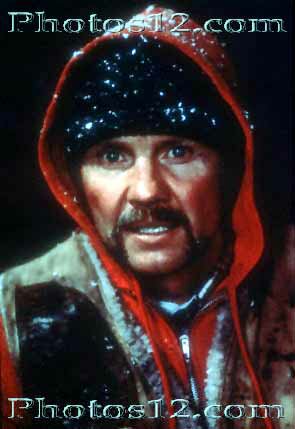
Whatever doesn't kill me makes me stronger!
Oscar "Manny" Manheim
Runaway Train
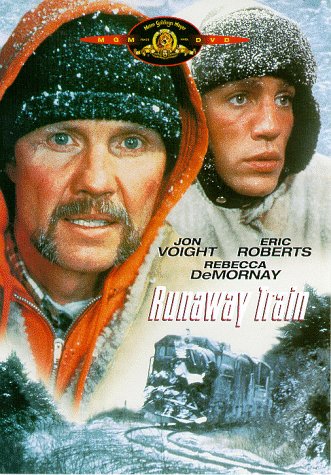
Runaway train starring Jon Voight, Eric
Roberts and Rebecca De Mornay was released in 1985. James Berardinelli
says in his review, "Jon Voight plays Manny, a
hardened criminal who is serving a life sentence in a maximum security
prison in Alaska. Manny has recently spent three years locked in solitary
confinement. Upon his release, he is hailed as a hero by the rest of the
prison population. One of his most ardent fans is Buck (Eric Roberts),
a dumb, garrulous, cocky rapist whose job pushing laundry carts becomes
a critical element of Manny's escape plan. With Buck
tagging along, Manny makes his way through the sewers under the prison,
out into the cruel Alaskan wilderness, and to a remote train station. There,
the two stowaway on a 4-engine train headed south, unaware that the engineer
has died of a heart attack, and the only one else on board is Sara (Rebecca
De Mornay), a female maintenance worker. The train is out of control and
rushing down the tracks towards a collision with destiny."
In an effort to slow and possibly stop the train, the trio tries to disconnect
the lines between the locomotives. To add to the excitement, the warden
has discovered they are on the train and tries to board via a helicopter.
I'll stop here so as to not spoil the ending which showcases some of the
finest acting ever captured on film.
There were Oscar nominations for both stars Jon Voight (Best Actor) and Eric Roberts (Best Supporting Actor) plus a nomination for Henry Richardson (Best Editing) at the 1986 Academy Award celebrations. At the Golden Globe Awards, Jon Voight was selected as a winner for Best Actor (Drama).
A private showing for railroad employees took place on January 20, 1986 at the Fireweed I Theater.
.
The Making of Runaway Train
The ARRC placed some tight restrictions on Cannon
Films regarding safety and they were not permitted to show the "Alaska Railroad"
name or logo on any piece of equipment. The filming took place in the
area of Portage, Whittier, Grandview and Tunnel. The film production company
did have a fatality during the filming wherein Rick Holley, a helicopter pilot,
was killed when his helicopter hit a power line in the canyon north of Tunnel
Section. This occurred on 9 March 1985 and was listed as "helicopter
accident en route to Alaska filming location."
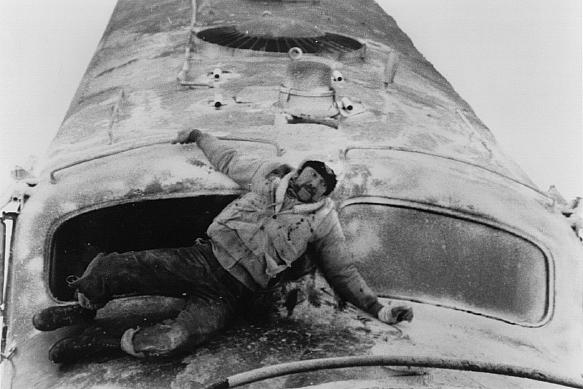
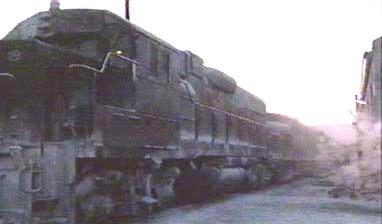
The film's locomotive lineup was a GP40, F7 #1500 and three ex-army GP7's with the ARR type-b trucks. On the units you will notice two distinct ARR trademarks; the high winterization hatch (CP or CN were about the only other roads that had such a tall hatch), plus the ARR plow which is unlike any others. For filming, water based paint was used so it could be later removed. Furthermore, some major modifications were made to the units themselves. Says Josh Coran, ARR Chief Mechanic, "The hood units were GP7s.....the props people converted them back to high short hoods. They had done so well that one day when I walked around the corner and ran into one it took me a long time (minutes) to figure out where this old high hood unit came from. Our Chief Engineer at the time, Obie Weeks, was an aspiring actor and since he was a member of Actors' Equity he got a part in the movie. He is a train crew member with the horrible line in which he refers to his "caboose man." instead of "conductor" (or "rear brakeman" or something a little more like a real railroad position). I did get the script changed a little. I objected to the scene in which Voight climbs out the cab window of the F unit and makes his way at great peril to the next unit. They made me feel better by having debris from the wrecked caboose jamb (the inward opening) nose door."
During the filming, the film crew didn't have as much snow here as they had anticipated and some filming took place in Montana. The historic Old Montana Territorial prison, built in 1870 and located in Deer Lodge, Montana, was used as one of the locations. They also rented an F unit and did some filming in Butte, Montana on the BA&P. The early train scenes in the movie are shot in the shop and roundhouse areas of the BA&P at their shops in Anaconda.
A "special" premiere of the film was held in Anchorage
since the majority of the scenes were shot there. [Webmaster's
note: This movie was being shown on the flight that took me on my first
visit to Alaska in 1986. What a coincidence!]
.
.
Additional notes from the press
kit:
"You have to be an optimist to make a film about
trains." director Andrei Konchalovsky states. "Working with trains
was very difficult, dangerous, and complicated. The engines were
an enormous amount of steel, very difficult to stop, and treacherous to
work around."
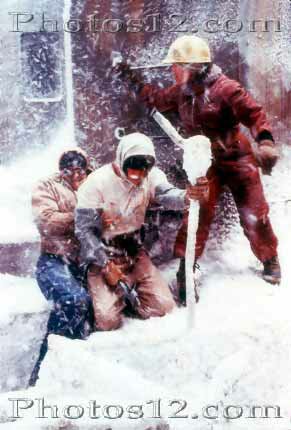
The film company took extra precautions to insure the safety of the crew. Not one shot was taken without everybody securely rigged or hooked to the moving train. They even hired trained mountaineers to guarantee that everybody who worked on the train was properly strapped.
The train sequences were filmed on the Seward main track of the Alaska Railroad, which runs from Seward, through Anchorage, and up to Fairbanks. The company shot on locations 60 miles up the mountains, with no roads, and were only accessible by helicopter or train. It was a wild environment, where bald eagles, moose an jack rabbits were seen almost daily.
Filming on the main track created a unique problem. Other trains were coming through on it. In the words of Ted Hewitt, the Alaskan railman assigned to the film, "The normal train traffic runs as it is supposed to. The movie train has to take to a siding and be clear of the regular train."
Therefore, three cameras were used to film most scenes. "It was necessary," Hume stated, "While making a run on a track, we had to get as many shots as possible before another train came through."
The filmmakers wanted to give the film a cold, severe look. And although the film was shot in color, they have given it a black and white look with traces of color added. This, they felt, would highlight the contrasting majesty of the Alaskan mountain wilderness, with its bleak trees and black rocks against the white of its snow. And it also heighten the image of the monstrous black train hurdling down the tracks under the bright white sky.
It was Konchalovsky's decision to make "Runaway Train" look as much like a documentary film as possible. Therefore, Hume and and camera crew placed their cameras in awkward positions, to make the picture look as uncomposed and spontaneous as if you just hung out the window with the camera, or were hanging by a piece of string on the edge of the train.
The prison sequences were filmed on location at the historic Old Montana Territorial prison in Deer Lodge, Montana, which was built in 1870, and was an operating prison until six years ago...
The remainder of the film was shot in train yards and studios in Los Angeles. The company also filmed in another historic landmark, Hollywood's Pan Pacific Auditorium, which currently is closed and awaits restoration. In this 400 foot wide, 200 foot long structure, they built an exact replica of the trains' engines and interiors, complete down to their rivets. There were constructed so they rocked backwards and forwards, and even twisted. Their couplings could be coupled and uncoupled,...even their speedometers worked."
Additional information from Rhys Davis, UK
Production notes
The lead engine was number 3010. I know this
because the cover of the UK DVD has a close up of the engine on the cover,
and the number is clearly visible, being the only part not shredded from
the collision. The irony here is that a photo of this engine is on the
banner on your home page, behind one of the SD70s.
Secondly, the fourth engine is definitely numbered 812, as it is not only visible when Manny and Buck board the engine, but it is chalked on the engineer's controls. You see this in a shot of Manny in the engineer seat before Buck starts talking about a bank job Manny pulled in Reno ("I was in reform school, that was so hot! Man, 2 million similoens, Man that was hot"). Whether these numbers are connected to the ARR or the BA&P, where the yard scenes were filmed, I don't know. (You can see BA&P written on the side of a tank wagon behind two yardmen as they see Al fall off the engine.)
Added 1/16/07: After a ridiculous amount of time rewatching Runaway Train I was able to identify the four locos in the consist - 3010, 1500, 1801 (it has a unique shape to the running plate over the fuel tank) and 1810 (rounded roof).
As for locations, I'm a bit short. The only one I'm sure of is that Jordan, where the train is nearly derailed, is Portage Junction. (After the signal maintainer says "I'll be g____, sonuva b____!" and changes the switch, you can see a set of wagons behind him on the third side of the triangle shaped junction).
As for alterations from the original script, there are many. The biggest difference from the plot is the chase sequence, where Barstow orders a set of locomotives to chase the runaway, hook up, and brake her. However, the chase is called off because they fear that if the runaway tears up Seneca bridge (located on the Whittier branch I believe), the pursuing train will be wrecked.
The Script
Akira Kurosawa's original script, entitled Boso Kikansha in Japanese,
was based on a similar incident that occurred in Rochester, NY.
It was originally to be bankrolled by Embassy Pictures, and started when the convicts boarded the train, calling for no prison sequences.
There were several large changes between the first-draft English script (credited to Djorje Milicevic as the writer and dated 15th January 1985) and the final production script. These were mainly smaller details, the main plot remaining unchanged:
SCENE 89. INTERIOR. EASTBOUND 12 -(COLLISION) - SAME TIME
The ENGINEER is on the phone in the cabin while his assistant is attending
to the shaken-up Caboose Attendant who bleeds from a cut on his face, but
is otherwise all right.
ENGINEER (EAST 12)
(shaken, enraged)
Sure she's gone! And she took my god damned caboose with her! You hear
me! Yeah, you better! I hold you responsible.
SCENE 90. INTERIOR. CENTRAL CONTROL TOWER - SAME TIME
The atmosphere is somber as they listen to the engineer's voice:
ENGINEER (EAST 12)
(on speaker)
You coulda killed my caboose man! It's your a__ I'm gonna --
Frank switches off the speaker and picks up the telephone, making an
attempt to appear calm.
Locations
Here is the yard plan of Anaconda
locomotive depot on the Butte, Anaconda & Pacific railroad (BA&P).
It is here that the yard sequences were filmed. Although this is an out-of-date
plan, the buildings remain in their original locations, although the track
layout is different to that of the film.
Manny and Buck first see the train when standing in the gap between
buildings 3 and 25, looking towards building 6 (the machine shop). The
locomotives are running right to left on this plan, out of the roundhouse
area. In the middle distance, buildings 6 and 7 can be seen, with a GP7
in BA&P livery pulling a row of flatcars onto a new line between the
two buildings. The locos then shift position and direction in the yard,
to pull up behind building three, and it is here that Manny and Buck board
them. In this sequence, you can see part of the roundhouse in the background.
Clark Street tower, where the engines shed their breaks, is actually
the BA&P headquarters. In the second plan this is the smallish hammer
shaped building on the far right, beside the main line.
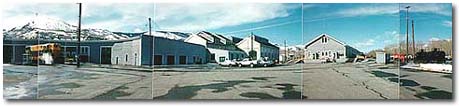
This the only image I was able to dig up of Anaconda. Thankfully, it shows both locations used in this part of the yard, if from an angle not seen in the film.
The large buildings to the left with ventilators on the roof are buildings 6 & 7 on the plan I sent you, while the one on the right is building 3. Also the roundhouse can be seen to the left, with a locomotive on the turntable.
With regards to the film, the engines would have been moving away from the roundhouse, down the gap between the two buildings where the cars are parked when the convicts first spot them. When Manny and Buck board them, they are lined up on the right of this photo, facing away from the camera.
Mistakes
Most of the mistakes and errors in the film revolve around the locomotives,
the most obvious one being that the Eastbound 12 continually suffers from
an identity crisis! When we first see it, the locomotive is a single GP40,
with its strobe light flashing and a lot of snow on the front. In the next
shot, it has changed to a pair of Alco MRS locomotives (number 1605 in
front), belching a lot of smoke (for which I hear Alco's products have
a reputation). The consist has also changed, from blue hopper cars to a
mix of flat and box cars.
In the actual collision, the caboose also changes color, from yellow, to gray. Also, if you watch the footage carefully, you can see that the caboose actually clears the runaway's path before the image switches to shots made using models.
In the yard sequence, where Manny and Buck walk beside the engines, the F unit is missing! In clear view, the lead engine is attached to a GP7, although a shot seconds before shows all four locomotives.
In the sequence where the train runs through a sequence of tunnels, there is a montage of shots of Manny yelling out the window of the second engine. Some of these are done in a studio, with the background scenery added to the film later, but some are definitely done on an actual moving train. However, in all these images, studio or location, the rear of the lead engine doesn't feature. It should be dominating the view forwards, standing somewhat higher than the cab of the F unit, but is nowhere to be seen.
In a sequence where Manny and Buck attempt to cross between the fourth and third engines, before the character of Sara is introduced, there is a prolonged shot of them climbing round the front of the fourth unit. You can clearly see the line between the actual engine, and the built-up section on the nose assembled by the props department! Also, the top section wobbles a lot more the rest of the engine. There is also a hatch in the top, presumably to allow access to the inside of the mock-up casing.
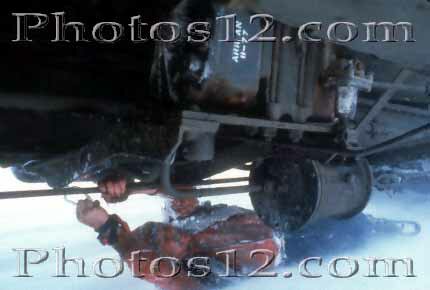
A final curio. If you visit the web site www.amazon.co.uk, and search in DVDs for Runaway Train, you will find an image of the cover of the UK DVD. The problem is, the cover features a behind-the-scenes photo! Not only is the train stationary (this was how I was able to identify the number), but there are men standing beside the third engine perfectly happily. They seem in the process of filming the final scenes as the lead engine is smashed up, but the cab window of the second unit is also wrecked, which only occurs in the last quarter hour. Not to mention, but the trivia notebook inside sports an image of Voight, or a stunt actor, under the train. It clearly shows the buckle to a jump suit which the actor is wearing, attached to a pipe on the train.
Cast and Crew
Director
Russian Director Andrei Konchalovsky emigrated to America from the
Soviet Union in 1980, but waited four-years for an American product that
suited him (Runaway Train), despite his eagerness to direct in the US.
While waiting he turned down offers to direct adaptations of Agatha Christie
and Stephen King novels.
Before accepting the project, he met with Akira Kurosawa, the original scriptwriter in Japan, in order to gain his approval.
His father, a poet, wrote the lyrics to the national anthem of the Soviet Union, "Gimn Sovetskogo Sojuza".
His grandfather, an artist was exiled for refusing to paint Stalin's portrait, but was later immortalized on a Russian stamp.
It was Konchalovsky who persuaded a reluctant Jon Voight to take on the role of Manny. Voight was convinced that Manny was "all wrong" for him, until Andrei told him that "actors who play against type" always make the best villains.
The Actors
Both Jon Voight and Eric Roberts received Golden Globes for their performances,
and were both nominated for Oscars.
In preparation for the role of Manny, Voight spent time with prisoners in San Quentin prison, remaining in contact with some after the production of the movie.
In order to make himself look less "innocent", Voight placed small obstructions in his nose to both flare the nostrils and make it look broken. He also wore a set of false teeth over his own to make them look damaged and brown.
Manny's Fu-Manchu mustache was suggested by Voight after he watched the 1978 prison documentary Scared Straight.
Eric Roberts, a black belt in Tae Kwon Do, said the role of Buck came naturally to him after growing up in a Mississippi neighborhood of ex-cons. For the role of Buck, Roberts put on thirty pounds of muscle by working out.
Additional note 6/5/03: "What may interest you is that I have found out another fact about the film. While surfing the net I found a website about a private railroad in Washington State which claimed to have supplied equipment for the film. I have worked out that this is loco. no 7012, an F9 shipped down to Montana for the yard scenes. The website is the official one of the Mount Rainier Scenic Railroad, 70 miles south of Seattle."
Additional note 8/12/09: "I thought this might interest you - I own Djordje Millicevic's draft of the Runaway Train script; not long ago another draft became available. This draft came about when Robert Duvall expressed interest in appearing in the film, but was concerned about the dialogue - as a result Cannon went out and got an ex-con to redraft the script; namely former Reservoir-Dog Edward Bunker (who also served as the template for Manny and appeared in the film as 'Jonah')
"I understand when Bunker did his first rewrite Cannon flew him out to
LA and put him up in a hotel to belt out a script and in places it shows, particularly
in places
where Millicevic's draft is unchanged or where the scene headers still contain
references to deleted sequences (i.e. the BF9 chase)
"Incidentally, scenes now contain little location notes (LA, MT, AK) suggesting that the filming locations had been locked by the time this was drafted; the script also contains the deleted scene at the Elkins Chemical Plant that was known to have been filmed at the Whittier Tank Farm, as well as explaining away why the Deadman's Switch on the locomotives didn't engage."
Additional note 10/1/09: Very interesting news John. My liner notes for the Runaway Train DVD contained a note saying that Kurosawa's original draft of the screenplay was based on a real-life runaway train that occurred in Rochester, New York State, that he read about in a magazine. However without a date for the incident, or any further details, I'd not been able to turn up anything. Until now.
I tried to find more details again tonight and pulled a result, finding a railfan forum where the very same issue was being discussed, and I learnt that the incident happened in 1962 and that the story was published the following year in Life Magazine. Luckily, Life have archived their issues from the past few decades on the internet, and I was able to find the right issue, and the account of a runaway train which menaced Rochester one night in the fall of 1962.
A train of four locomotives ran wild after their engineer was incapacitated, with a single person trapped on-board. This person was a sheet-metal worker for the New York Central who was inspecting the sandboxes on the #2 engine when the train tore loose.
The similarities are so clear that its almost certain this article was what inspired Kurosawa's original draft of the screenplay, right down to some of the names, locations, and incidents; the head dispatcher for the area (just like in the movie, a Mr MacDonald) was, like his fictional counterpart, dragged out of bed to take control at dispatch; an aborted proposal was made to derail the train near a town called Jordan, it crossed a bridge over 'the Seneca river' way above the speed limit, another train narrowly missed a collision with the runaway, and its locomotives then attempted, and failed, to catch up to it.
A second pursuit locomotive was readied in the hopes of putting a man on the runaway and stopping it before it reached Rochester, where the train would almost certainly derail on a tight corner, most likely crashing into a small soap-and-chemical factory located there.
However, by this point, the man on board, after realizing his dilemma, but
unfamiliar with the operation of locomotives, began pressing buttons, and finally
hit the shutdown switch in the #2 unit; moving forward he then parted the jumper
cable between locos #1 and #2, then wasted time by going back and shutting down
#3 and #4, not realizing that in parting the jumper cable he'd set them to idle.
Finally he made his way forward to the lead engine and hit 'an interesting red
button', the fuel cut-off, which shut the train down just outside Rochester.
The full article can be seen here,
starting on page 79.
Additional note: 10/2/09: I'm working on a transcript of the
article, and a comparative list of place names, locations etc that appear in
both the film and the real-life incident. It's attached at the bottom of this
message
I also found a second account of the story online, published in a newspaper or magazine in response to the famous runaway of CSX loco #8888 in Ohio a few years back;
Fabius man recalls wild ride on a runaway train in 1962
By Richard Palmer
When Joseph P. Gerace of Fabius read reports of a runaway train on CSX recently it brought to mind a similar and even more hair-raising experience he had on a windy fall night in 1962.
It was on Oct. 26, 1962 Gerace, then a young machinist employed by the New York Central Railroad in East Syracuse, was doing some work on a new EMD GP-20 which was coupled to three other identical units at the fueling station, near the old DeWitt diesel house. The engines had just been fueled and were scheduled to go out on NC-1, a westbound fast freight.
At the time, Gerace was on the second unit filling out a work car, and an engine hostler , Bob Cox was making a brake test when something went wrong. Cox either jumped or fell off the locomotive while the throttle was engaged in the eighth notch - wide open. This was about midnight.
A peculiarity with these locomotives was if the throttle was engaged, the engine would rev up power and eventually start to move, even if the brakes were on. The usual way to stop this was to shove the throttle ahead and then reverse it to shut it down.
The brakes were on, but they did not hold, and the locomotives started to move. Gerace said he thought the engineer was on the lead unit and the engines started to move. But he then lost sight of him and the locomotives started to move down through the yard.
Peter Walters, a road foreman of engines at DeWitt, was just getting out of his car when he saw the locomotives go by at about 25 miles per hour, with the brakes on and fire flying all around the wheels.
Walters called the engine house to find out if they were grinding the wheels on these units, as was sometimes done in this manner. He was told they were not, and suddenly someone reported that NC-1's engines were gone. Gerace said he expected the engines would derail at any moment due to the rough track in the yards. But he remained on board because he didn1t want to risk trying to get off if they derailed.
As fate would have it, the switches were properly aligned so that the engines eventually got out on to the main tracks and headed down the old passenger main through Syracuse which had recently been taken out of service. An unsuccessful attempt was made to try and catch them with a yard engine, but by the time the reached the "throat," or west end, the engines were going 35 miles per hour on track 1.
The train dispatcher on duty at that time was Sam Giglia, and when he was advised of the situation, began clearing track 1 of trains as fast as he could. Meanwhile, the interconnected locomotives were picking up speed and were soon going passenger train speed, or better.
The locomotives of BF-3, a westbound fast freight, were cut off on a siding at Newark, and were prepared to give chase once the runaways went by. But by the time they got to Newark, they were traveling at 75 miles per hour.
Meanwhile, an engine was posted on track 2 in Brighton, hoping to cross over behind them and catch them. A passenger train was tucked away at the station in Rochester. Its locomotives were also poised to give chase.
Officials decided
to deliberately ditch the engines off on the siding at Chili, west of Rochester,
if necessary, as it was considered unsafe to try to let them go into Buffalo
at the speed they were going. This in spite of the fact that officials were
fairly certain there was a man aboard the second unit. The runaway flew by
Clyde, Lyons, Newark, Palmyra and Wayneport. Meanwhile, Gerace was doing his
best to stop it. Unlike the earlier so-called "covered wagon" designed
locomotives, one had to go outside along a precarious walkway, protected only
by handrails. "The wind
was really blowing," Gerace recalled, as he raced from one unit to another
pulling cables and shutting off switches.
Gerace first thought there was someone in the lead unit, and was only after they left DeWitt yards he realized he was the only one aboard. The engines continued to accelerate, and when he saw that they were going more than 100 miles per hour, he said he prayers, and crouched down in the nose of the engine.
A short time later he decided since
he was a goner anyway he decided to try do something, ad at least try to stop
the engines. He opened the cab door and climbed along the running boards of
to the rear of the unit he was on, reached down and disconnected the large
jumper cable between the second and the two following locomotives. By that
time the runaway is said to have been
traveling more than 100 miles per hour and the centralized traffic control
center, then in the Rochester station, lit up like a Christmas tree.
The jumper
cable itself contained a series of 27 wires which were plugged into a socket
and locked in place by a cap. After he disconnected the cable, "I could
feel the engines slowing down," he said. The speed dropped back substantially.
He then went back into the cab and saw that the speed had dropped back to 60
miles per hour. So he got his courage up, and went back
out and climbed over to the lead unit, went inside, threw all the switches
he could find, until finally one of them killed the motors on the lead unit.
The units coasted for a long distance, finally coming to a stop, rolling backwards a few feet. By this time the brakes were burned up and were useless, and Gerace recalled he put some ballast on the track to halt the engines from coasting..
When it was fairly certain that the units had stopped, they were on track
1. A locomotive came east from Rochester and cautiously down track 2 when
Gerace saw the lights of an approaching engine. He nervously got out three
or four fusees, ripped the caps off, but threw them away before he realized
he needed them to ignite the fusees. When the engine arrived on the scene,
he was scrambling on the ground looking for the caps to the fusees.
Speed tapes on the engines only record as high as 92 miles per hour, but as an indication of the actual speed they attained, they covered the 4.6 miles between Lyons and Newark in two minutes flat, which equals 121.8 miles per hour. Brake shoes were worn down paper thin, and were laced with fine cracks, and were red colored, indicating the intense heat they had undergone.
The 6100 series locomotives were 2,400 horsepower road switchers and were valued at about $250,000 each at the time. Other than burned out brakes, which were easily replaced, there was no other damage to the locomotives.
To this day there has been no explanation as to how or why the engine man got off in the yard. An article on the incident was subsequently published in Life Magazine. For his efforts in saving the locomotives, Gerace was awarded $650 in savings bonds by a grateful New York Central for saving $2 million worth of locomotives.
Gerace at different intervals spent 14 years on the railroad. He said his father and uncles were also railroad men. After the "diesel house" in DeWitt was closed by Conrail in the early 1980s, he ran his own business for several years before retiring.
But he said he will never forget that harrowing
experience of riding a runaway train nearly 39 years ago.
*
Hope that's interesting for you - I find it fascinating how closely this incident
matches the early draft of the script I have (credited to Djordje Milicevic,
from the script by Akira Kurosawa), which I have come to the conclusion is either
a fairly close translation of a Japanese text written by Kurosawa based on research
into the Rochester incident, or a rewrite of Kurosawa's script by Milicevic
with the Rochester incident in mind, as so many things match (including the
description of the locomotives starting at the fueling depot, then reversing
to an inspection pit, then reversing back over a switch before moving forward
once more and running wild). Everything seems to sync, including the name of
the switch tower where the runaway is let onto the main line, which in both
reality and the movie is named 'Clark Street Tower', and characters;
PEOPLE
Joseph 'Jim' Gerace > Sara Maguire (in reality and first draft, both are railroad
employees checking on the 2nd unit's sandboxes)
Sam Giglia > Frank Barstow
Robert MacDonald > Eddie MacDonald
Bud Weaver > Dave Prince
Robert Cox > Al Turner
David Fleming > Wright
Unnamed Foreman > Cassidy
Stanley Davis > Pulasky
Bill Welch > Dick Nova (railroad employee present in first draft)
Unnamed NC-1 Road Crew - Cushman and Brown (railroad employees present in
first draft)
TRAINS
NC-1 (4 GP-20s) > Runaway
Unnamed Eastbound Freight > Eastbound 12
BF-3 (5 locomotives) > BF-9 (5 locomotives, 'chase' train present in first
draft)
COPIED PLACE NAMES
Clark Street Tower
Seneca Bridge
Jordan
Lyons (station mentioned in first draft)
Port Byron (station mentioned in first draft)
Interviews with Runaway Train "Insiders"
Mary Pignalberi
Former Director of the State
Film Office
Mary Pignalberi, former Director of the State Film Office, helped woo Cannon Films into making the movie Runaway Train in Alaska. She said they were looking at the various major railroads, but all were federally owned and therefore couldn't get what they wanted. The Alaska Railroad was in the midst of a transfer to state ownership which made it very appealing to Cannon Films. A deal was soon struck.
After some initial negotiations with the railroad, the film company submitted a script in the fall of 1984. Shooting began in early 1985. Mary emphasized the railroad was very cooperative. They even used one of their outfit cars as a catering car.
There was a party at Girdwood following the shooting of the film. It was held in what used to be the main hotel and had plenty of music, food and celebrities.
One other activity that took place was a small luncheon at the Sheraton in Anchorage. Mary, Alaska Railroad VP Frank Turpin, Governor Sheffield and a few others were in attendance. Jon Voight, in true Hollywood style, flew into the luncheon via helicopter.
Mary saw Jon Voight in Los Angeles several times after the movie was completed. She said Jon had fond memories of Alaska. He had even learned to ski while there.
Obie Weeks
Former Alaska Railroad Employee and Actor
Obie Weeks, the only Alaska Railroad employee to appear in the movie Runaway Train, was kind enough to provide some facts regarding the actual filming of the movie.
All the yard shots took place on the BA&P in Montana. There was almost no snow in Montana that year so all the other railroad shots were made along the Alaska Railroad. The three feet of snow seen on the tops of freight cars was actual fresh snow.
The Alaska Railroad insisted that all their logos, color schemes and locomotive road numbers be camouflaged. The film crew stayed at the Alyeska resort Potato flakes were used to simulate falling snow. Pilot Rick Hollie was killed when his chopper caught on a telephone wire and crashed.
As far as filming location was concerned, much of it was made along the Portage flats and around Spencer. There are several locations in particular that I remember. Portage is the location used when the old man is told by the dispatcher to throw the switch and derail the train. The train crash with the caboose occurs at the Spencer siding. The Seneca bridge (and tunnel) sequence is filmed in the Whittier area. The same tunnel is used at the end of the movie when the train breaks through the barricade on a dead end siding. Ron Sims drove a Hy-rail through the barricade and wound up ruining the filming camera.
My appearance in the movie is onboard an old Army ALCO [number 1605]. I am backing the train into the siding and have the lines, “Central, central, east bound 12…..Why did you stop us?…..I don’t see any runaway…My God!” As an actor, it was the only union job I ever held.
Once the film was complete, there was a big opening ceremony in Anchorage. All the actors and crew attended the event except me since I was in Wisconsin at the time. I did meet Jon Voight and Eric Roberts during the filming and found them to be very nice people.
Additional information from John Rosa (6/15/10)
I'm currently watching and rewatching all the train scenes of Runaway Train
in preparation for creating an HO-scale replica of the 4-loco runaway. And
in my travels on the web, I came across your page on the subject (and several
others) and using the info there and what I see myself in the film, I've come
to a couple of conclusions that help clarify the whole "loco numbers" arguments.
Let me know if the following makes sense to you.
Most (including Wiki) state the locos used were all ARR units, starting with
GP40-2 #3010, F7 #1500 and the GP7's, #1810 and 1801.
Fair enough- I'll concede the many more-distant shots of the 4 locos in motion
in the wilds of Alaska are the 4 units listed.
However, I firmly believe, as is standard Hollywood practice, that all exterior
scenes showing the actual actors moving on or near stationary locomotives were
shot in Montana (less severe weather = happier actors) using entirely
different, more-local locos (which is why many state the second GP7 is number
812...because it IS #812- it's seen plain as day several times). The shots
of the guys running past the stopped locos (no F7) and boarding them showed
just three local Montana locos...possibly three GP7's in a row (with #812 at
the rear).
The exterior scenes with the real actors on "moving" locos were most
likely on the mock-ups at the Pan-Pacific Auditorium where they could guarantee
safety, and use rear-projection behind the actors to show the passing Alaska
scenery.
Here's the revealing shot for me: The stationary shot of the four locos
(including the F7 with plow) that we see as Manny is peering out thru the last
GP7's vents. This must have been shot in Alaska, right? But this shot
(shown quickly, twice) isn't the GP40-2 we see for the rest of the
film! On the GP40 we see moving throughout the film, behind the cab, is a rectangular
grille followed by the dynamic brake. But in the stationary shot (and the shot
of it first beginning to move forward), between that forward grille and the
brake, is a higher access door/tool box of some sort. It's seen better as the
train just begins moving forward. This is a GP38-2! And we never see it
again as #3010 takes over for the rest of the full-scale shots. Oh, and #812
is replaced by another GP7 (# x53x, where 'x' = unknown digits) when the camera
is placed alongside the moving train to see the last engine passing real close
to the camera as it leaves the yard.
My own replica is going to wear only numbers plainly visible in the film (alternately,
they'll be as obscured as they were in the film), so that only F7 #1500 and
GP7 #812 will be made obvious, and the other two will be very hard-to-impossible
to read (even thou 3010 is fairly easy to spot as the dying conductor exits
the cab).
Lots of Hollywood editing trying to cover the changing availability of the locos!
Another thought: The F7's jammed front door. It's mentioned on your page that collision debris caused the jam. Two problems with that. One- there's no debris between the GP40 and F7 at any point. Two- the jammed door isn't the full-height outer door- it's the inside crawl-thru door in the cab, between and beneath the windshields. So in reality, there's no more reason needed for this door to be jammed than to say the latch is simply old and faulty, and the guys don't have the tools or strength to break it free.
Additional information from Production Designer Steve Marsh (12/14/10)
Yes I remember making that picture many years ago. We had to start by shooting all the second unit footage in Alaska and Montana. That meant that we had two sets of engines that did not quite match so we had to disguise them with plywood, paint and pretend snow.
The main body of the picture was shot in Los Angeles. We built two of the units on stage and shot using back projection techniques. We also built the whole train two more times in two scales of miniature. These miniatures worked for the crash scenes which we shot in a disused winery in Rancho Cucamonga, California.
Once all this footage was cut together I think you will agree that the illusion was quite complete.
I made one more picture with this Director, Andrei Konchalovsky, it was called Shy People and we shot it in the swamps of Louisiana!
Regards,
Steve Marsh
Also check out the photos on his website.
Additional information and photos from Jonathan Fischer (12/27/11)
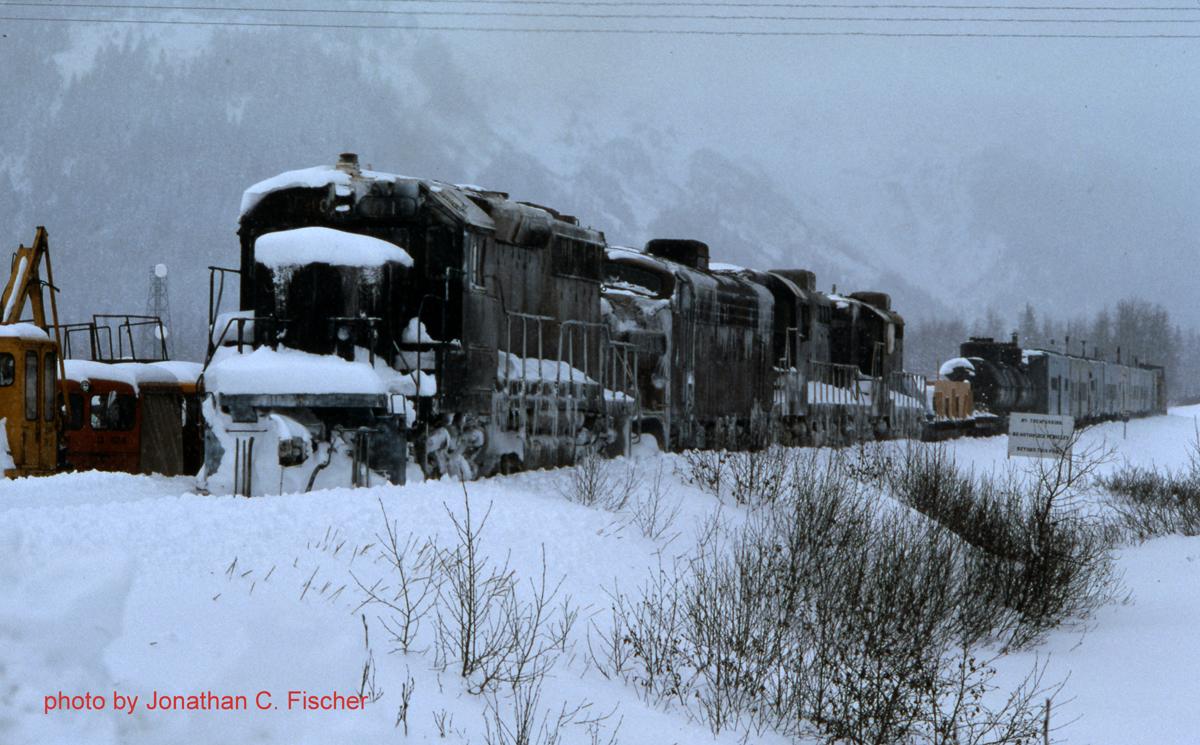
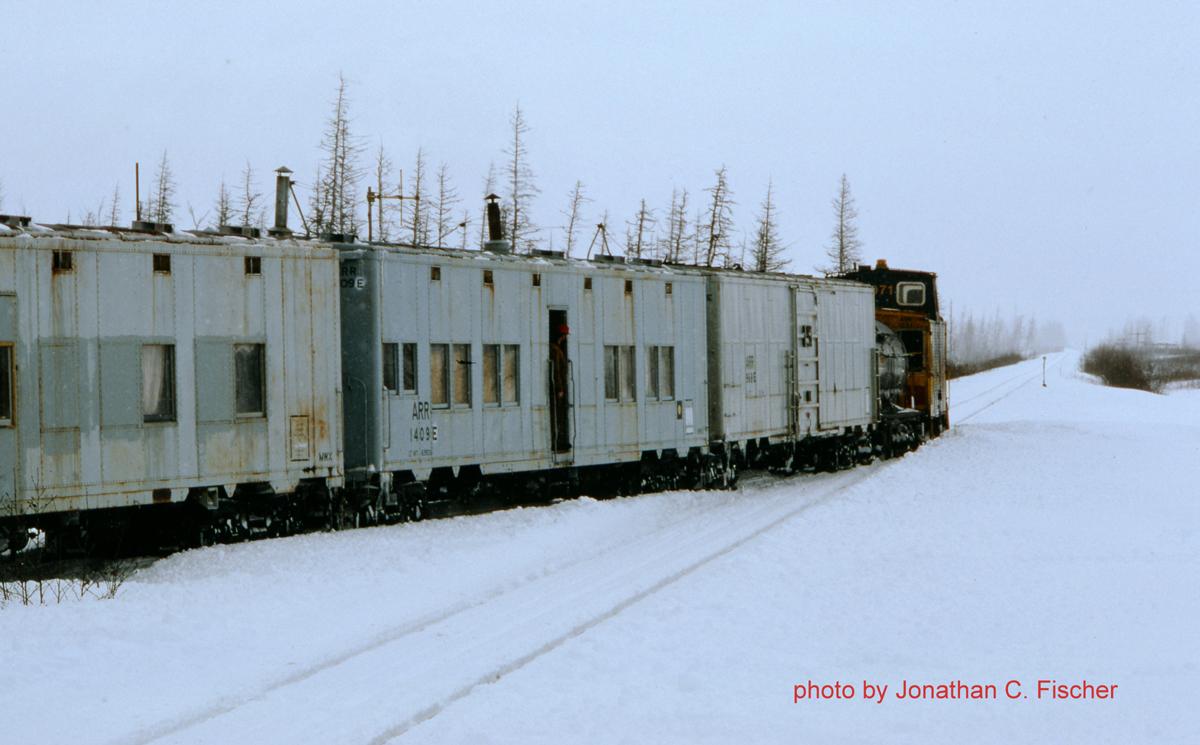
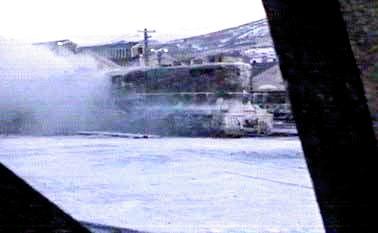
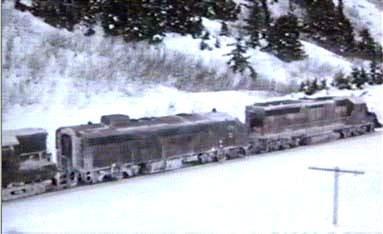
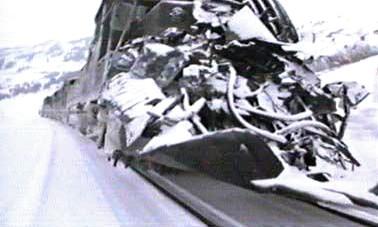
These slides have APR 85 dates, so I'm assuming that I must have taken these in March of that year. We (Mark Hemphill and I) had known about the train for a couple of weeks, but the weather had been more grim than usual. So finally, since filming was to conclude soon, I made the trek down to Portage anyway. I can still feel the snow/rain/sleet/freezing rain and the ever present wind when I look at these pictures.
I found the train sitting on the Whittier branch. There were a bunch of trailers for the movie folks in the parking lot. There were movie people milling around the trailers. As I was struggling to get out to the train (as the fresh snow was waist deep) a movie employee told me that I couldn't go back to where the train was and that the area was off limits. I replied that it was OK as I was a railroad employee and kept going.
 |
 |
| Photo of the consist. | Here's the second shot. |
 |
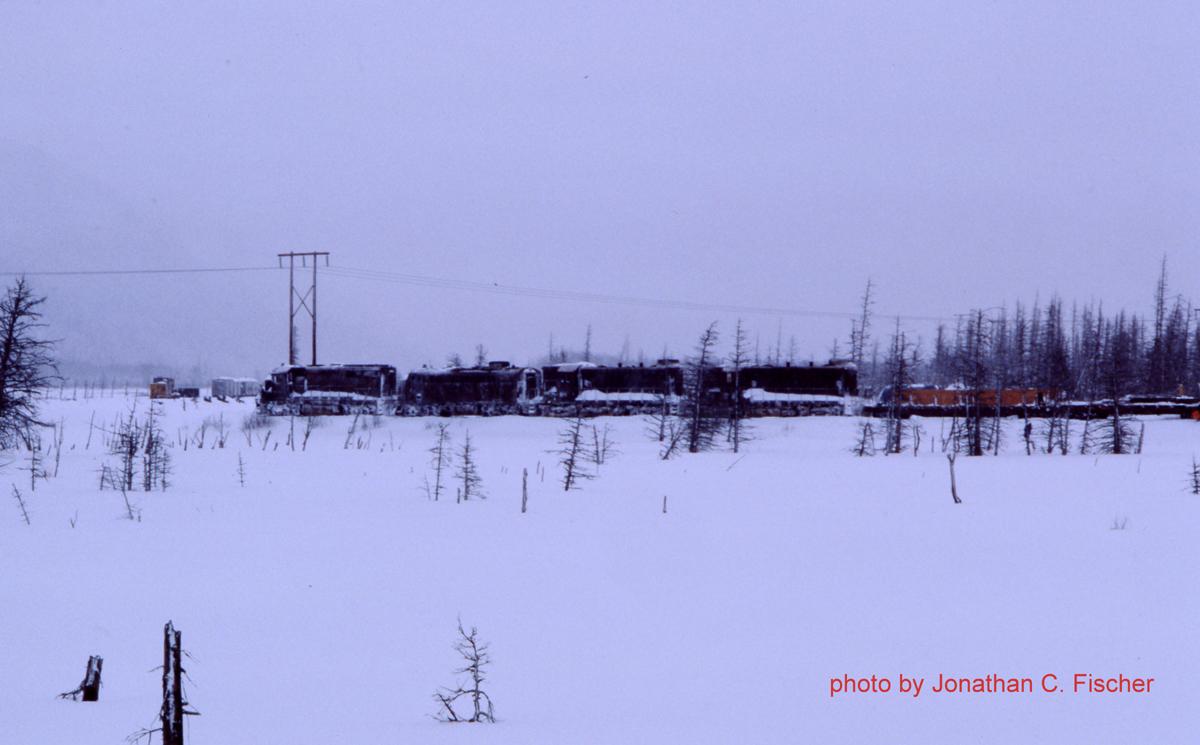 |
| Here's the third shot of the end of the train showing some of the work equipment. | Somewhere else it was warm and sunny. Not here. The crew finished turning the train and it tied up in the Portage yard. |
Additional information and photos from Gary Lund (4/11/13)
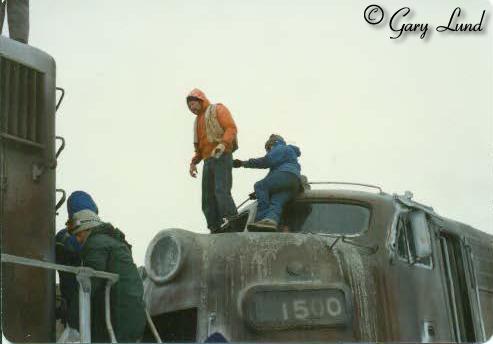
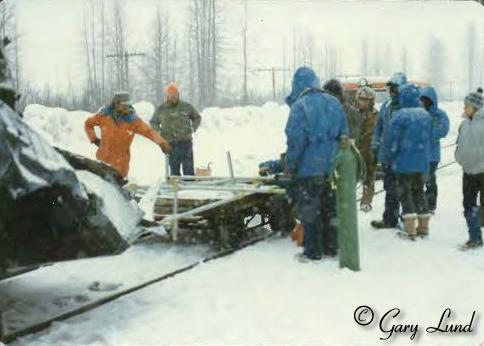
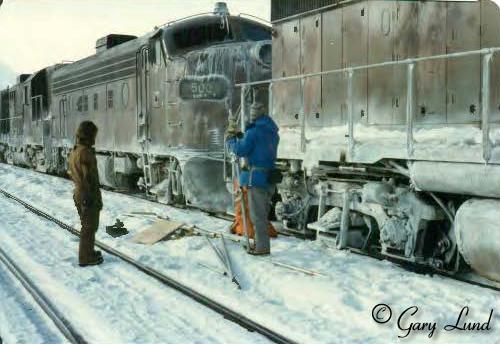
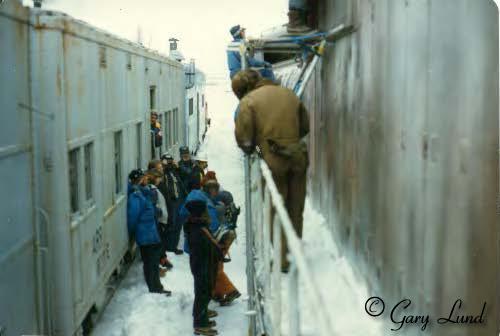
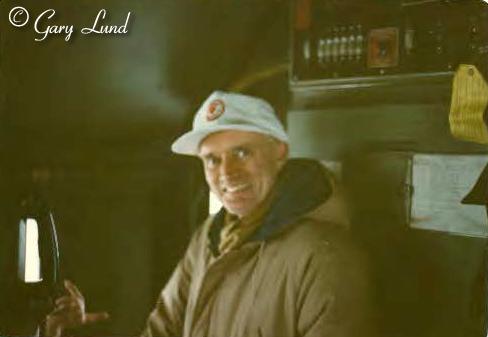
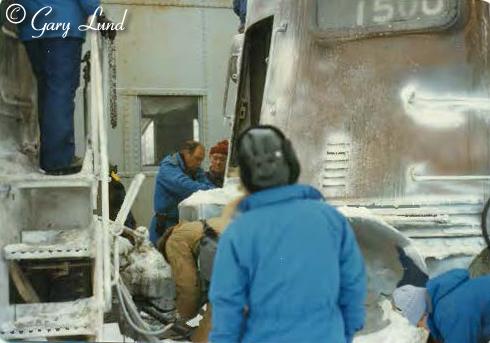
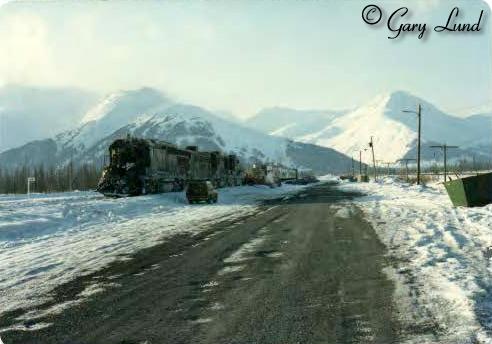
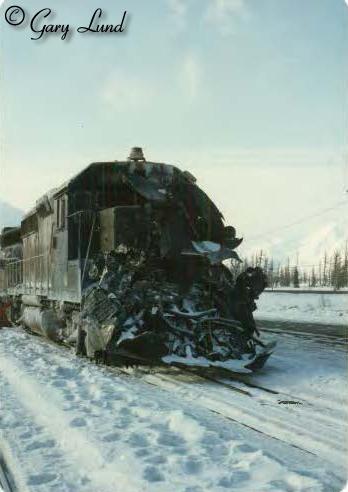
Well, I was called as an engineer for a couple of weeks because I think Ted Brummond went on vacation. He was a senior engineer who had bid the job in. It was a 6 day a week assignment,12 hours a day. I was told that the film crew wanted to work on Sunday (their day off) one week. Everyone agreed to work it, except Ted. Everyone, meaning the conductor, brakeman and Ted Hewitt. They offered him (Ted) 500 dollars plus his 12 hour pay day. And he refused. Someone found out that Jon Voight was getting paid 100,000 dollars a week for 10 weeks. Jon Voight was a very nice, professional individual. We mostly worked between Grandview and Portage stations. We stayed at the Alyeska resort. All those gray cars were old passenger cars from the 1920's through 1940's. Then they were turned into track or extra gang crew cars. The film company turned one car into an office, another into a kitchen (I think it was a kitchen), another into a dining area, etc. I remember they were spotted, or left for the day at Spencer siding. Then the whole train would go to Girdwood for the night. I remember the film crew took the Alaska Railroad locomotives inside the old Chugach Electric Association power plant (big green building) by Ship Creek and fixed up the one engine with the wrecked stuff on the front. I did the air test on the original engines leaving the Anchorage Yard Area for Portage. Gary Knudson was the brakeman on the job when I was there to replace Ted Brummond. I am pretty sure Pat Small was the Conductor. The man whose picture I sent you was a film company executive. I did speak to Andrei Konchavelosky one time. I said a few words in Russian and he was excited that I spoke a little Russian. There were two UK film workers that rode with me in the cab one day. They told me that they had traded cigarettes with Ted Hewitt. English for American smokes. I remember the scandal of the railroad workers crashing into the huge mirror at the first door to Whittier from Portage. I wasn't there when it happened, but I heard about it. I understand they were to race up to it, but not crash into it.
 |
 |
 |
 |
 |
 |
 |
 |
 |
 |
 |
 |
Alaska Railroad Number 1500 History
When the Alaska Railroad purchased their first six F7s
from EMD in 1952, she was the first (and last) F7A to be put in service
on the ARR. She was later retired
and given to the Museum
of Alaska Transportation and Industry (MATI) in Wasilla.
Click here to view a YouTube video on some of the stunt work from the movie.
For more information check out the Internet Movie Database listing for Runaway Train. It has a nice trivia section which includes items taken from my website.
Additional information from Rhys Davis (10/24/13)
I had a delightful surprise last night—a friend met Jon Voight and sent me a personal message from Jon where he cited the "itty bitty spot" speech.
That got me motivated to do a bit of Runaway Train trawling and I landed on something unexpected, some B-roll footage from the movie archived on YouTube.
The big takeaway here includes full uninterrupted cuts of the Runaway approaching 'Jordon'/Portage, running down the side of the 'Eastbound 12' and STOPPING before reaching the caboose, a look at the models used for the collision, a glimpse at just how badly the snow had thawed in Montana, and no less than FOUR Alco MRS locomotives (1605, 1606, 1603 and one other) lashed up for the 'Eastbound 12', with Obie Weeks hanging out the cab and false "A&E Northern" road-markings on the long hoods.
Page created on 3/14/00 and last updated 10/24/24.